Sunday, October 16, 2011

PHILOSPHER-EMPEROR


A review of Frank McLynn's Marcus Aurelius: A Life (2009)

(Rating 2 of 5)

Frank McLynn's account of the life and world of Emperor Marcus Aurelius does lack for detail. McLynn explains the life of a young Roman aristocrat who lives in a world of increasing inequality. To use a modern phrase, the rich are getting richer and the poor are getting poorer. To put a more precise point on it, the Augustan Principate as a system government now seems to be suffering from the same fate as the Republican Senatorial establishment that it had replaced. Rome is facing great troubles and the government that is supposed to solve Rome's problems is either ignoring them at best or encouraging them at worst.* Gaining the notice of the Emperor Hadrian, young Marcus is adopted into the imperial family and is put on the direct path to the imperial throne. After an over two decade stint as the presumptive heir under Emperor Antonius Pious, he ascends to the imperial throne. As emperor he does many things but very little to solve Rome's larger problems.

Frank McLynn comes across in his writing as very knowledgeable about various topics, unfortunately it can somewhat drag his writing down. I understand why stoic philosophy is important to understanding Marcus Aurelius as a person. So McLynn, as the biographer, feels the need to explain stoic philosophy. However in contrast with author Anthony Everitt, who was able to explain stoicism in one page with a few examples**, McLynn not only dedicates a whole appendix to it, but he also drags on for entire chapters on the Emperor's view and writings on the topic. It is also one thing to sum up how his work is observed in later time periods when discussing his legacy and impact in the final chapter, however in the middle of the book I do not need to know how the Emperor's philosophy measures up Immanuel Kant. Often while reading this book I felt the need to yell “Get to the point, already!”

The structure of the book leaves a lot to be desired. For example I like to have my table of contents to tell me the pages of each of the individual chapters not just the introduction, preface, and appendixes. As a reader I find that a full table of contents helps me pace myself while reading. As a reviewer a full table of contents in a book it makes the book easier to go back over. He also has inconsistent capitalization of titles, McLynn will sometimes capitalize titles and other times he will not. For example, you will see King Louis IX of France and emperor Hadrian of Rome.

During the course of the book McLynn often refers to Marcus Aurelius as the 'greatest of the emperors of Rome' even occasionally adding the adverb 'unquestionably'. The funny thing is, the way Marcus Aurelius and his reign are described in the book gives the reader the impression he was a substandard emperor at best. This could highlight the author's low view of all of Rome's emperors—his views on Hadrian are very different from Anthony Everitt's. Nevertheless it comes off as an odd claim. I, myself, tend to judge leaders on three main criteria. The criteria I use are: how did the state*** look before leader X took over; how did leader X respond to the problems that he or she encountered; and what was the condition of the state when leader X left relative to when his or her time began. Clearly, the 'greatest emperor' was Augustus. He entered politics when Rome was being rocked by civil wars, he ended the civil wars and established a new form of government far more effective than the earlier one it replaced, and left Rome more powerful than ever in the stable hands of Emperor Tiberius.**** In contrast, Marcus Aurelius is handed Rome from Emperor Antonius Pious—who I always viewed as being a sort of Calvin Coolidge of Ancient Rome, an emperor who neatly managed the Empire, tended to trust his subordinates to do their jobs, with no major crisis hitting the Roman Empire during his watch as head of state—; his response to the problems that faced Rome were only effective in the short term (he defended the borders but had never quite solved the problems); and lastly he left the Roman Empire to his psychopathic son, Emperor Commodus.

In the end, I would recommend this book to someone with a strong handle on academic jargon and love of philosophy. If you just want to read about Rome stick with Adrian Goldsworthy.

*This is my personal observation not the author's.

**Everitt discussed Stoic philosophy in his book Hadrian and the Triumph of Rome when explaining the Stoic opposition to the Flavian emperors.

***You can substitute 'state' with kingdom, empire, or organization of any kind.

****Emperor Tiberius was not always great but at the start of his reign he was not that bad. In general, he was a capable ruler.

{Scene from the movie Gladiator, not a very historically accurate movie but Richard Harris plays a very good Emperor Marcus Aurelius}

Sunday, August 28, 2011

AT THE HEIGHT OF POWER


A review of Anthony Everitt's Hadrian and the Triumph of Rome (2009)

(Rating 5 of 5)

Antony Everitt's biography of the Emperor Hadrian is very different from his earlier biographies on the Emperor Augustus and the orator Cicero. The reason is the difference of subjects' time periods. In the two earlier books, one system, the Republic, is coming to an end, while a new system, the Principate of the Roman Empire, is established. Cicero tries to save the Republic and dies in the attempt, while Augustus creates the Principate and rules until his seventies. When Hadrian was born the Principate had been established for over a hundred years. Rome was now in the reign of Emperor Vespasian, who took over at the brief interruption of the Pax Romana, the Year of the Four Emperors. Hadrian would be born a citizen of Rome, living under the rule of emperors until ultimately becoming the Emperor himself.


(Emperor Hadrian)

Hadrian's family came from the province of Spain, his ancestors having settled there after the Second Punic War. Through political connections his father would rise to become a senator of Rome. Because of his family and the fact that his father died when he was rather young he received a guardian named Trajan. Trajan was a soldier who would also rise to the height of Roman society by wearing the imperial purple.


(Hadrian's guardian, adopted father, and predcessor: Emperor Trajan)

Everitt's biography of Hadrian is actually a history of Rome during the mid-imperial period. While Hadrian rises through the ranks of the military and Roman upper-class senatorial society, Everitt also tells the story of the Flavian dynasty of Emperor Vespasian and his two sons, Emperors Titus and Domitian. The three emperors do battle not only in the field but at home in the Senate. The Stoic opposition, senators who resisted these three emperors with civil disobedience, to use a modern term, are quite a handful for the three rulers.

When Emperor Domitian is assassinated he is replaced by a senior senator named Emperor Nerva. Nerva has a short but important reign, he is known as the first of the five good emperors, who guide Rome in what is regarded as its Golden Age. Emperor Nerva adopts Trajan as his son and successor. This puts Hadrian in direct contact with the imperial throne. He works his way up during Trajan's reign, fighting in the army and assisting in the administration of the Empire. He is adopted by Emperor Trajan and succeeds him upon his death.

The book then goes in to the reign of the middle emperor of Rome's five good ones. Hadrian as an emperor was active, liked to travel though his empire, and was generally a good ruler. Emperor Hadrian stops Rome's conquests, wishing to change the Empire's mission from unlimited expansion to defense and internal improvement. Hadrian is a great builder who improves the city and the provinces. Everitt tells of his love affair with Antinous, his trials in the Senate, and his undying love of Greek culture.


The only one complaint I have about this book is the capitalization. I realize I should not care that much but I really cannot stand it. ‘Emperor Hadrian succeeds emperor Trajan as ruler of the Roman empire.’ Seriously, it drives both me and my grammar check nuts. Everitt has retained this practice from his book Augustus, but he did not in Cicero.

Nevertheless this is a great book and I recommend it to anyone who is interested in the Roman Empire and its rulers.

{Video posted from YouTube}

Saturday, August 27, 2011

A BOY ARMED ONLY WITH HIS NAME


A review of Anthony Everitt's Augustus: The Life of Rome's First Emperor (2006)

(Rating 5 of 5)

Anthony Everitt tells the amazing story of the young Gaius Octavius, who grows up to become the man we know as Emperor Augustus. Everitt gives the treatment of Augustus’ life the same way he treated the orator Cicero's. Everitt has an easy to follow narrative that guides the reader from the chaotic early life to the stable rule as the first Emperor of Rome, or what Augustus called his new regime: the Principate.

Born during Cicero's consulship, the young boy grows up in the period of political instability that would result in civil war. His granduncle, Julius Caesar, would be one of the primary actors and winner of the first round. The young boy's life is changed forever when the Dictator is assassinated and he is named Caesar's heir. As Caesar's adopted son, he has Caesar's name as his (only) weapon. It turns out to be a really good weapon as he is able to raise an army and challenge the famous general Mark Antony for control of Rome. Everitt tells the story of them ultimately teaming up and combining their forces to defeat Caesar's assassins, Brutus and Cassius, at the battle of Philippi ending all hope of a restored Republic.

“When they disagreed, it was always Octavian who got his way. When he wanted something, he tended to pursue it with single-minded intensity, whereas Antony, seeing himself as the senior partner in government, had the careless self-confidence to give way.” (p.133)

Woe Unto Rufus Tranquillus.

The Second Triumvirate is unstable and it is not long until civil war resumes and the future Augustus and his number one man Agrippa defeat the forces of Antony and Queen Cleopatra at Actium. Antony and the Queen decide to commit suicide than fall into the hands of the merciless young Caesar.


From there on the story is about Augustus' long reign as emperor. Everitt explains the various settlements that were made that let Augustus build up so much power that eventually would create a new indispensable position in Rome. He would redesign the city, and that new design would allow him to gloat that he found Rome made of brick and left it made of marble.


On a slight side note there is one odd difference between Everitt's work on Augustus and his biography on Cicero. The difference is in capitalization. In the previous work, Everitt chose to capitalize titles—which I prefer—and now he does not. I have noticed a change in trend when in grammar when it comes to titles. As a reader of many books it is easy to see the change and I do not like it. I do not know who is leading the charge but I wish they would stop. I much prefer to see Emperor Tiberius of the Roman Empire than emperor Tiberius of the Roman empire—heck even my grammar check thinks this is wrong. The former looks elegant and clean, the later looks like a pile of written horse crap. I am going to be reading another book by Everitt and I hope he returns to his old habits as opposed to his new ones. Nevertheless, I highly recommend this book it is a great and exciting read.

{Scenes from the HBO classic series Rome}


Wednesday, August 24, 2011

THE GREAT ORATOR


A review of Anthony Everitt's Cicero: The Life and Times of Rome's Greatest Politician (2001)

(Rating 5 of 5)

Anthony Everitt's biography of Marcus Tullius Cicero is an enjoyable book to read. Everitt has an interesting writing style. In some ways he is something of the throw back, which I like in certain respects and in others I don't care as much. I like the way he capitalizes titles. Many writers do not do that anymore (Robin Seager hardily capitalizes anything) but it is something that I like to see. Unfortunately, he does not have any footnotes in the main text, that would please Theodore Roosevelt if he reading this book, but I prefer them. He is well researched and all his sources are listed in the back and identified line by line, but I prefer footnotes because they are easier to use.

Everitt takes the reader on a guide though one of the more interesting lives in one of the most interesting times. It is amazing how great events seem to be surrounded by such colorful figures. During his career Cicero would meet and interact with Marcus Crassus, Cato the Younger, Pompey the Great, Julius Caesar, Marcus Brutus, Mark Antony, and Emperor Augustus. In an age where every politician wanted to be a warrior, Cicero makes a name for himself in the Forum as an orator and advocate instead of commander of legions.


(Marcus Tullius Cicero)

The reader follows Cicero's career as he climes the cursus honorum. It is hard for a 'new man'--one who does not have a senator in his family—to clime the ranks of Rome's offices. But he becomes consul and saves the Republic he loves from the forces of Catalina. However saving the Republic is short lived because its problem was institutional, which—as Everitt points out— was something Cicero could not see. To Cicero, Rome's problems were personal. Cicero felt if the Republic had better men to lead it then its problems would be solved.


“Having thought the matter over Cicero convened a meeting of the Senate early the next morning. It may have occurred to him that Crassus, rattled by Catalina's behavior and to avoid the being implicated in some wild adventure, had himself arranged for the mysterious letters to be written and 'delivered.' That did not matter; the important thing was that he at last had something that looked like proof. Once the Senate had assembled, Cicero handed the letters to their recipients, who read them aloud to the meeting. They all contained information about a plot. Next a report was given on the formation of regular bands of soldiers in Etruria; it was claimed that Manlius would take the field on October 28. The Consul asked to be given emergency powers.” (p.102)


(Cicero saves the Republic)

As time goes on, Rome sees the rise of the First Triumvirate, which he refused to join, and his own life get torn apart by his archenemy Clodius. Cicero recovers just in time for the civil war, an event which angers him to no end. He hated the people on one side and the cause on the other. During the reign of Caesar, Cicero becomes just a sarcastic voice in the Senate.

When the Ides of March come, Cicero career gets immediately revived, and he plays a huge role trying to bring down Mark Antony. But to no avail, the rise the Second Triumvirate ends his dreams and his life.


I really enjoyed this book it tells the tale of relatively minor player, but a great one nonetheless, in one of the more fascinating periods in the history of the world. I would recommend this book for anyone for it is extremely well done.

Video was posted on YouTube by Frasergray95 scenes from the HBO hit series Rome}

Monday, August 22, 2011

A MAN WITHOUT AN EQUAL


A review of Adrian Goldsworthy's Caesar: Life of a Colossus (2006)

(Rating 5 of 5)

In the over two thousand years since Julius Caesar was assassinated, many authors have written books about the great general and statesman trying to understand him. Was he a hero or tyrant? A visionary or a just a practical politician? Caesar is a hard man to nail down despite being one the most written about men in ll history. However, I feel I can say with absolute confidence that Adrian Goldsworthy has truly captured the essence of Caesar and has succeeded in writing in—what I feel—is the book on Julius Caesar for the twenty-first century. If you want to know about just who Julius Caesar was then this is the only book on him that you will ever really need. You do not have to be a history buff to both understand and enjoy this book*, Goldsworthy writes a smooth narrative that is devoid of any technical history jargon that usually infests most historical works.

Julius Caesar did a great deal in his fifty-six years on this Earth. Goldsworthy covers his childhood, his time aboard, and his political rise. Throughout the book, Goldsworthy avoids any trace of presentism and also continuously reminds the reader to avoid using hindsight to come to conclusions about events. He also is carefully not to judge one side in a conflict more harshly than the other and does his best to maintain a historian’s impartial distance.


“Roman rule brought to Gaul and other provinces many advantages. At a most basic level it is not unreasonable to say that more people were better off living under the Roman Empire than they were before it came or after it failed. The faults of Roman society—and there were many—were often shared by other cultures including the Gauls. Slavery is an obvious example. The violent entertainments of the arena, which came alongside literature, art and drama as part of Rome's influence, were less usual. Caesar was not responsible for Roman imperialism or for Roman culture, although he was certainly an enthusiastic agent of the Republic's expansion. His conquest of Gaul was not a fulfillment of a long-term aim or ambition, in any sense other than that he had long craved the chance to win glory. It was chance and opportunity that led to him focusing his attention on Gaul.”(p.354-5)


(Caesar accepts Vercingetorix's surrender)

“The benefits of Roman rule are arguable but the grim nature of Roman conquest is not. Caesar was entirely pragmatic—effectively amoral—in his use of clemency or massacre and atrocity. During the course of the conquest of Gaul his soldiers did terrible things, sometimes by order, as when they massacred the Usipetes and Tencteri, and occasionally spontaneously, as when they slaughtered women and children at Avaricum. Other Roman armies under other commanders had done similar things in past and would continue to do so in the future. Indeed atrocities as bad, or even worse, were committed by virtually all armies in the ancient world. This is not to justify what Caesar did, merely to place it into context. Warfare in antiquity was generally an extremely cruel business.”(p.355)


After Caesar's conquest of Gaul he comes home to find his enemies have backed him into a corner. He can either back down in humiliating defeat or do what other disgruntled Roman generals had done since he himself was a boy: invade Rome. The Roman Civil War has become a romanticized period of history. Much like World War II, the Roman Civil War is given a story-like narrative filled with the colorful figures of the age. The power struggle between two of Rome's greatest leaders and their allies locked in a bitter conflict where there can only be one winner.


“The greatest battle of the war, fought by armies commanded by the ablest generals of the age, was about to occur and inevitably sources recounted the great omens that foreshadowed this massive shift in fortune.” (p.425)


For this book does not just feature Caesar. During his life Caesar encountered incredible people. He was the nephew of the great Maris, the son-in-law of Cinna, and he stood up to Sulla when no one else would. Among his colleges during his career were allies such as Crassus, enemies like Cato, friends such as Cicero, and the most intriguing of all Pompey the Great. Caesar and Pompey were two great friends who would become the greatest of rivals. However his most famous encounter is with the great Queen of Egypt.


(Caesar meets Cleopatra)

“When Caesar arrived in Egypt Cleopatra was nearly twenty-one years old and had been queen for almost four years. She was highly intelligent and extremely well educated in the Greek tradition. Later, she would be credited with writing books on a very broad range of subjects. Cleopatra was a noted linguist who it was claimed rarely needed an interpreter when conversing with the leaders of neighboring countries.” (p.438)


One of the insights Goldsworthy makes that I find the most fascinating, is he compares Caesar's two great errors: miscalculating the mood of the Gallic aristocracy and miscalculating the mood of the Roman aristocracy to be, in fact, the same error. In both cases he felt that since his rule was good and benevolent that those who had opposed him would come to his side. In Gaul, he managed to prevail and conquer but in Rome he lost his life.


Death of Caesar
“Caesar tried to change this. In 49 BC he feared falling into the hands of his rivals, just as they were terrified of his returning at the head of an army. In each case the fears may have been ungrounded, but that did not make them any less real. Once the war began Casear paraded his clemency, sparing defeated enemies and in time allowing them to resume their careers. This was calculated policy, intended to win over uncertain and deter the enemy from fighting to the death, but that does not reduce the contrast with his opponents or earlier victors. After he had won, the pardoned Pompeians were allowed back into public life and some treated very well indeed. Once again he clearly felt that this was more likely to persuade them and others to accept his dictatorship. Regardless of his motives, there was a generosity about Caesar's behavior that was matched by no other Roman who came to power in similar circumstances. In the same way, while his lifelong backing for popular causes was intended to win support, at the same time he did implement a number of measures that were in the interest of a wide part of the population.” (p.515)


Goldsworthy is right to title this book the life of a Colossus because that is what Caesar was. His life and legacy left a huge impact on the world that very few historical figures can compare. His legacy still looms large even today for both myself and my county celebrates our birthdays (July 3 and 4) in the month that bears his name.

*Although you probably are a history buff if you are going to read this. After all, who else is going to read an over five hundred page book about Julius Caesar?

{Video is from the already classic HBO series Rome, to which the author was a consultant}


Saturday, August 20, 2011

A GREAT MAN OVERSHADOWED


A review of Robin Seager’s Pompey the Great (1979, original) (2002, my copy)

(Rating 4 of 5)

I remember once reading, in a Batman comic of all things, a quote that asked how many great champions are known not for their victories but how they were done in by time and a new generation. Does anyone remember Sony Liston for anything else other than being beaten by Muhammad Ali? Although there are a great many historical figures who legacies survive defeat—Hannibal, Napoleon, Robert E. Lee, and Erwin Rommel are great examples—Ca. Pompeius Magnus does not seem to be one of them. On Amazon a list for ‘Pompey’ only four books came up that were just about Pompeius, two that were about him and Caesar, and the rest were about the famous city or other people with ‘Pompey’ in their names. After the first page, Pompeius does not appear much. Caesar on Amazon has endless works about him carrying into the hundreds. It is strange that Pompeius is confined to the dustbin of history; he is just part of Caesar’s story not a character in his own right. Robin Seager does a great job of telling Pompeius’ own story, in which Caesar plays just a part and only shows up half way through.

The book begins with a summary of the major historic events that had happened to Rome since the fall of Carthage. The Republic was coming to pieces because it could not, with rare exception, function as intended. Pompeius starts his career by raising a private army in the service of the Roman Dictator, Lucius Cornelius Sulla. Pompeius earns the nickname the ‘young butcher’ in his early service to Sulla.


“On a practical level it seemed best to Sulla to find Pompeius further immediate employment. So Pompeius’ position was for the first time placed on a legal footing. He was invested with praetorian imperium by decree of the senate and sent in pursuit of Carbo, who had fled, when the resistance to Sulla collapsed, and despite his pleas for mercy he was put to death and his head sent to Sulla. His defense of Pompeius in 86 might have given him cause to hope, but Pompeius was never to show any hesitation in betraying old friends when the occasion demanded. For him his link with Carbo must merely have underlined the need to prove his loyalty to Sulla by a suitably harsh and dramatic gesture.”(p.27)


After the Marian forces are defeated Pompeius embarks, first under Sulla, then under a restored Republic, on a career that—for a time—makes him the greatest Roman that had ever lived. He becomes the golden boy who has victories all over the Empire. He wins in Africa, Spain, and Greece. He lifts the pirates from the Mediterranean Sea, and settles the Greek east for the Roman Empire. He serves as consul but his career takes an interesting turn when he forms the ‘First Triumvirate’ with Marcus Crassus and Julius Caesar. The triumvirate dominates the Republic for the next decade. Pompeius holds on to power in Rome while Caesar conquers Gaul and Crassus gets himself killed in Parthia. This leads to a standoff with two of the greatest leaders in the history of any civilization. As it was said centuries later as battle between a man who could not accept any other as an equal (Pompeius) vs. the man who would tolerate no superior (Caesar).

“What would Pompeius do if Caesar wanted to exercise it while still retaining his army? ‘What’, said Pompeius very gently, ‘would I do if my son wanted to take a stick to me?’ This reply puts his position in a nutshell. He saw himself as a father, Caesar as his son. In that there was a message, for the optimates could rest assured that Pompeius would act to keep Caesar in his place, subordinate as a son should be to his father, but they were also being warned that he was still not prepared to abandon Caesar, that a bond still existed between them as close as that between a father and his son. Similarly Caesar could read in the words a promise that Pompeius would not forsake him but protect him as a man should his son, but only if he accepted that he owed obedience to Pompeius as a father.”(p.143)


Pompeius chooses to fight for the cause of the optimates but, in opposing Caesar, Pompey is chased out of Italy and in the first time of his life he tastes defeat at the battle of Pharsalus. He has to run as his friends abandon him. Pompeius flees to Egypt where a pharaoh who owes him his crown is expected to provide assistance in his time of need. Pompeius is instead greeted with murder.

The story of C. Pompeius Magnus is one of glory and tragedy. He is raised as high as anyone can go only to be defeat at the hands of one friend and killed at the hands of another. Robin Seager wrote a great book that I would recommend to anyone who wanted to learn more about the famous general Pompey the Great.

{Video was uploaded on YouTube by Princepsmaximus the scenes are taken from the 2003 TNT movie Julius Caesar}

Wednesday, July 27, 2011

A MAN WHO THOUGHT HE WAS A GOD AND A WORLD THAT THOUGHT HE WAS RIGHT


A review of Alexander the Great: Son of the Gods (2001) by Alan Fildes and Joann Fletcher

(Rating 5 of 5)

Alan Fildes and Joann Fletcher wrote this book, Alexander the Great: Son of the Gods, to tell the tale of the world's greatest conqueror. Their book is unique by the amount of space the dedicate to Alexander's time in Egypt, which they consider to be very important to his development and to his ideas on his own divinity. This book's structure and format have a very strong textbook feel to it. The chapters are subdivided into little sections and there are feature boxes that are within but excluded from the main text. The book contains a lot of incredible visuals, such as maps, images of ancient statues, medieval works of art, and present day photos of places where Alexander had been.

This work starts out as a traditional tale of Alexander, discussing the conditions of Macedonia, Greece as a whole, and the Persian Empire that long threatened Greece long before Alexander's arrival. The authors tell the story of how Alexander's dynasty got started and how his parents King Phillip and Queen Olympias came to be married. Alexander grows up between two parents who despise one another while being tutored by one of the greatest minds ever, Aristotle's.


(Alexander's parents)

Alexander becomes the King of Macedon when his father is assassinated. As King, goes to war against the Persian Empire. After defeating Darius III in battle at the battle of Issus and achieving victory at Tyre he heads south. The two authors focus a great deal on what happened to him when he was in the land of the Nile.


(The Alexander Mosaic)

“With the whole of Asia Minor now his, Alexander was free to pursue the Persians east into their own heartlands. However, knowing that would take Darius at least a year to muster a new army after his defeat at Issus, Alexander chose instead to go south to Egypt. Although often regarded by later historians as little more than an eccentric diversion, Alexander's six-month Egyptian sojourn was essential to his future plans—he required a strong coastal base for both strategic and commercial purposes. However, the founding of the city of Alexandria was not the only legacy of the young king's time in Egypt. His stay there was marked a major psychological turning point in his life, for it was in Egypt that he became convinced of his own invincibility and divinity.”(p.52)


Leaving Egypt the Pharaoh, he goes on to challenge King Darius for the rest of his empire. Defeating the King of Persia at the Battle of Gaugamela , Alexander spends the rest of his life mopping up the pieces of his newly won kingdom, stretching his empire all the way to India.


(The battle of Gaugamela)


After his death the authors give the best detailed account of break up his empire amongst his generals that I had ever read. The book also tells the tale of Alexander's tomb that for centuries was located in Alexandria. Now no one knows where it is! If it is ever found that discovery would make the discovery of King Tutankhamen's tomb pale by comparison. According to the authors it was how Alexander conquered and ruled that was his greatest legacy for he single handily ushered in the Hellenistic Age.


(Alexander's Macedonian Empire)

I recommend this book to anyone who would like to know more about Alexander the Great the unstoppable conqueror who saw himself as a god.

{Video is from the History Channel's Battles BC series.}

Tuesday, July 26, 2011

ONE NATION ON EARTH WITH ALL THE OTHERS


A review of George C. Herring's From Colony to Superpower: U.S. Foreign Relations Since 1776 (2008)

Part of the Oxford History of the United States Series

(Rating 5 of 5)

Before reading this book I had read a series of history books in order to experience a march through the ages of American history. From Colony to Superpower is a march through the ages all by itself, exploring not only how America developed as a nation but also how, throughout its existence, dealt with its brother and sister nations of the world. The book begins with Thomas Paine and finishes with the Administration of George W. Bush.

In Herring's work the reader sees America as a mixture of idealism and realpolitik. Physically, America was formed as the foreign policy of another nation, Great Britain. However, in a very real sense America was born of an idea. An idea that was illustrated beautifully by Thomas Paine in Common Sense in which he proclaimed that we have the opportunity to start the world anew. That idea that was made official when Thomas Jefferson, with some edits from Ben Franklin, produced the Declaration of Independence in which they proclaimed not only their own independence but laid down what they thought were the rights of all mankind. The only major republic in a world dominated by monarchies, this idea could be heard in Abraham Lincoln's Gettysburg Address and a half century later when Woodrow Wilson asked Americans to make the world safe for democracy. Yet, even when American leaders were idealistic at their best they could lay down their dogma and be extremely practical. Whether it was John Quincy Adams writing the Monroe Doctrine or Ronald Reagan deciding to cooperate with Gorbachev, idealism had to be meet with practical reality.


(Thomas Paine, author of Common Sense)


(Writing the Declaration)

One of the common themes of this book is that isolationism is a myth invented by twentieth century politicians. The United States was always active in the world around it. Our most famous documents, such as, the Declaration of Independence, the Emancipation Proclamation, and the Constitution itself were statements from the United States of America to the world of our intentions. Herring points out in this book that every American generation had at least one war. Instead of isolationism America had engaged primarily in unilateralism, acting own its own accord doing what it thinks is best. Unilateralism served the United States well in its early days and up to the start of the twentieth century. President George W. Bush would try bring back unilateralism, but that would lead only to debt and disaster.


(Although not known for being a great president, John Quincy Adams, ranks as one of the greatest secretaries of state we ever had)


(The Great White Fleet showed America to be a rising world power in the time of President Theodore Roosevelt)

Herring also discusses a lot of the negative aspects of U.S. foreign policy. The book explains some of the crazy filibustering that went on in the antebellum era, especially in the 1850s. Herring also covers a good deal about ‘blowback’ the price America pays for some of its foreign policy choices. An example of blowback is the United States' negative reputation in a great deal of Latin America due to choice alliances that we made during the Cold War. What can seem like a good and particle decision at the time can come back with deadly consequences.


(America as won of the two superpowers as MacArthur accepts Japan's surrender)


(Henry Kissinger, one of the leading architects of late twentieth century foreign policy)

Herring is extremely fair with almost all the actors in the history of American foreign policy. He treats Democrats, Republicans, liberals, conservatives, idealists, and realists the same. When evaluating them if he thinks they deserve praise he gives it and when he is critical of certain actions he writes about what they did wrong and could have done better. The end he concludes that America has to continue to remain engaged in the world it will need to act more respectful.


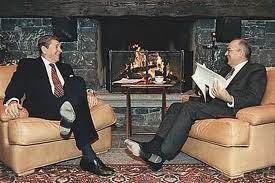
(Reagan and Gorbachev toward the end of the Cold War)


“Even if in decline, the United States will remain a crucial player in world affairs, and in coping with the challenges of a new and complex era the nation has a rich foreign policy tradition to draw on: the pragmatism of the peacemakers of the American Revolution; the basic realism of George Washington, Alexander Hamilton, and John Adams; the practical idealism of Thomas Jefferson and Abraham Lincoln; the worldliness and diplomatic skill of John Quincy Adams; the remarkable cultural sensitivity of diplomats such as Townsend Harris and Dwight Morrow; the commitment to public service of Elihu Root and Henry Stimson; the noble aspirations for a better world espoused by Woodrow Wilson; the intuitive understanding of the way diplomacy works—and its limitations—and the 'world point of view' manifested by Franklin Roosevelt in World War II; the coalition-building of Dean Acheson and the Wise Men of the Truman years and the George H.W. Bush administration during the first Gulf War; the strategic vision of Richard Nixon and Henry Kissinger; the ability to adapt and adjust displayed by Ronald Reagan; the efforts of the countless men and women who sought to share with other peoples the best of their country and to educate their fellow citizens about the world.”(p.963)


I also want to mention that on a technical note I love the footnotes at the bottom of the page as opposed to the end of the book or chapter. This way I do not have to flip back and forth while I am reading the book.

In the end I highly recommend this book to anyone who is interested in history or foreign policy. It is at times tough to get through seeing that it is over nine hundred pages, however, it is well worth the effort.

Sunday, July 24, 2011

AN ACTIVE GIANT


A review of James T. Patterson's Restless Giant: The United States from Watergate to Bush V. Gore (2005)

Part of the Oxford History of the United States Series

(Rating 5 of 5)

My final stop on my march through the ages is James T. Patterson's Restless Giant. This volume has a very different feel from both Patterson's previous book Grand Expectations and from the Oxford series in general. This book is more upbeat than the previous; this could be due to the material. Grand Expectations leaves you a little emotionally down in a reflection of the disappointment of the time period. In contrast, Restless Giant is written with the optimism of the 1980s and 1990s, where America, in winning the Cold War, seemed as if it were invincible. The title of the book is a clear spin of one Admiral Yamamoto's statement of America being a sleeping giant that he had awakened by attacking Pearl Harbor. This book is also very different from the rest of the Oxford series because, unlike the earlier volumes, this book is features an era that I actually lived through. I was born in 1981, so my life begins basically in chapter 5 and the rest of the book covers the events of my youth.

The story begins in the 1970s in the aftermath of Watergate, Patterson does his best to uncover this brief little era, in which a public first supports President Gerald Ford but begins to soar towards him in as he pardons his dishonored predecessor. Ford finds himself replaced with the humorless Jimmy Carter, who in turn presides over one of the worst economies since the 1930s. In keeping the tradition of the series, Patterson explores this era from all sides. He tells the story of the ordinary people, the social trends, new gadgets, and entertainment that the people enjoyed. It is a decade I am glad to have just missed.

The 1980s and my life begin with Ronald Reagan having vanquished Jimmy Carter in the 1980 election, ushered in a new conservative era. Although Patterson points out that even though conservative politics were becoming popular it was hardly a triumph equal to the liberals in 1932. The Democrats still held the House and Reagan while eager to pay lip-service to conservative domestic polices, he was not that interested in promoting them. Reagan chose instead to focus mainly on U.S. foreign policy. Reagan's foreign policy would be credited with winning the Cold War for the United States. Patterson also discusses horrors of the era, such as, the coming of the AIDS epidemic, and some the lighter moments such as the beginning of MTV.


“Reagan, moreover, was not so doctrinaire a conservative as liberals made out. While fond of damning big government—and of denunciations of 'welfare queens'--he recognized that liberal interest groups had effective lobbies on the Hill, that major New Deal—Great Society social programs—many of them entitlements—were here to stay, and the rights-consciousness had become a powerful political force. He understood that though people said they distrusted government, they expected important services from it.”(p.163)


The chapter covering the era of George H.W. Bush is known simply as 'Bush 41'. There is a strong argument to be made that of all the presidents to be featured in this book he was the most successful. Unfortunately, he will never be look at in that regard because he is cursed as a one-termer in his lost Bill Clinton in 1992. Although he had 'neo-cons' in his administration, the first President Bush was not as dominated by those view points as his son would be over a decade later.

Patterson begins to cover the nineties, which saw the end of the Industrial Age and the beginning of the Information Age. As the first baby boomer to assume the presidency, Bill Clinton gave Americans the impression that they once again had a very young Kennedy like president. Like Kennedy, he makes a lot of errors and also has his triumphs. And also like Kennedy, Patterson covers more of the former than the later. Nevertheless, I feel that Patterson gives Clinton a fair treatment.


“Extraordinarily well informed about domestic issues, Clinton had impressed many party leaders when he headed the Progressive Policy Institute, a think tank that blossomed after 1989 within the ideologically centrist Democratic Leadership Council. Like a great many boomers, he liberal positions on a range of social issues such as abortion and health care, but though he had the populist touch of a campaigner, he did not position himself of the left. A moderate as governor, he distanced himself as a presidential candidate from liberals like Mondale and Dukakis, who had been badly beaten in 1984 and 1988.” p.248


I was a teenager in the 1990s and my political options were beginning to form. So reading about the Clinton years was like reliving my youth in a way. Of the course the news that dominated the headlines was the Monica Lewinsky affair and the unjustified impeachment of President Clinton by his relentless partisan opponents. Clinton's behavior brought on a lot of his own misery, but his opponents’ behavior was worse because they attacked not only Bill Clinton politically, but the office the President as an institution. Clinton in standing up to these attacks, I believe, ended a deterioration of power that had been chipping at the presidency since Nixon resigned*.


“If Clinton's near-legendary luck had held out—as it might have done if he had been chief executive during pre-Watergate days when reporters had turned a relatively blind eye to the promiscuity of politicians—he would have joined a number of American presidents who had engaged in extramarital relations without being publicly exposed while in office.”(p.388)


The book ends with the controversial election of President George W. Bush over Vice President Al Gore. The first election that I ever voted in was one that was finished by the United States Supreme Court. I was very disappointed the time because I thought the election was outright stolen. I now, in agreeing with Patterson but having this opinion before, feel that the election had instead just fallen off a bus. (I have often thought about what might have been.)

Before ending I have to talk about this one part of a paragraph in chapter 8—the chapter that deals with the culture wars of the 1990s:


“Though many publishers and bookshops struggled to break even, fiction by highly talented authors—Toni Morrison, Alice Munro, Anne Tyler, Richard Ford, John Updike, and others with smaller name recognition—sold well. So did excellently researched works of non-fiction. James McPherson's prize winning Battle Cry for Freedom (1988), a history of the Civil War era enjoyed huge sales.” (p.288)


Now Battle Cry for Freedom, I believe I both read and reviewed that book. If memory serves that is the Civil War volume of the Oxford History of the United States series, which is the same series as this very book! David Kennedy, the current editor, must have yelled out 'GO TEAM' when he read those words.

All in all, this is a great book. It is interesting reading events that took place in your own life as actually history. I strongly recommend this book to anyone who wishes to know more about the time decades preceding the attacks of September 11.

{The first two videos are from YouTube thanks to the Miller Center of Public Affairs and the third is from Saturday Night Live}

Monday, July 18, 2011

EXPECT GREAT THINGS


A review of James T. Patterson's Grand Expectations: The United States 1945-1974 (1996)

Part of the Oxford History of the United States Series

(Rating 4 of 5)

My march through the ages has me now arriving at James T. Patterson's Grand Expectations, covering an era where my grandparents were building their families and my parents were kids. Since this book is about the recent past it is far more tangible than anything I have read so far. It begins in the world where America—with her allies—had just one World War II. Everything seemed so perfect for America was all-powerful, the world's most free nation that had just freed the world, the reforms of the New Deal will protected us from another Great Depression, and science would soon cure everything.

Very soon however the American people were about to learn that they were far from invincible, several members of their nation's minority populations were not free, and the nation had some tough times ahead. This was not entirely a bad thing for although grand expectations* had led to some great disappointments those disappointments led to people great and small to take actions to make things better. At the beginning of this book half the nation is still legally segregated and the opportunities for minorities and women were extremely limited, at the end legal segregation was dead and things in America had changed greatly for those oppressed peoples. The battle for equality was far from over but things were very different.

Like the rest of the series this book covers America from various directions. It looks at the top from the various administrations of Harry Truman, Dwight D. Eisenhower, John F. Kennedy, Lyndon B. Johnson and Richard M. Nixon. It explores things from the point of view of civil rights leaders such as Thurgood Marshall, Martin Luther King, Jr., Rosa Parks, and Medgar Evers. The book even takes a look at some of the more extreme activists such as Malcolm X, who was for most of his career a black nationalists and not a believer in equality. The book examines at the sixties counterculture and the famous concert at Woodstock. It also covers the average Americans who were just trying to get along with their lives and who really enjoyed the show 'All in the Family.'


(President John F. Kennedy and First Lady Jackie)


(President Johnson sworn in after assassination)


(Controversial civil rights leader Malcolm X)


“No performer aroused more alarm than Elvis Presley. Elvis, twenty years old in 1955, was the son of poor Mississippi farm folk who had moved into public housing in Memphis when he was fourteen. HE pomaded his hair and idolized Brando and Dean, whose Rebel Without a Cause he saw at least of dozen times and whose lines he could recite from memory. Presley learned to sing and play guitar while performing with local groups, often with people from his Assembly of God congregation. In 1954, he recorded 'That's All Right' and a few other songs, mainly in the blues and country traditions, thereby exciting Sam Phillips, a local loved black music and had recorded such musicians as B.B. King earlier in the 1950s. But the color line barred them from fame. 'If I could find a white man with a Negro sound,' Phillips is reputed to have said, 'I could make a billion dollars.'” (p.372)


(Rock icon Elvis Presley)


“The civil rights act was nonetheless a significant piece of legislation, far and away the most important in the history of American race relations. Quickly upheld by the Supreme Court, it was enforced with vigor by the State, for there were many thousands of hospitals, school districts, and colleges and universities affected by provisions of the law. Although many southern leaders resisted, most aspects of enforcement proved effective in time, and the seemingly impregnable barriers of Jim Crow finally begin to fall. Black people at last could begin to enjoy equal access to thousands of places that had excluded them in the past. Few laws have such dramatic and heart-warming effects.”(p.546)


There are some parts of the book I am very critical of. The book lacks a type of poetic feel that was present in previous volumes such as Gordon Wood's Empire of Liberty and David Kennedy's Freedom From Fear. Also often this book strongly leans to the negative. I am not saying one should not be critical when need be, for example there are several sections in David Walker Howe's What Hath Good Wrote that are very critical at times but nevertheless has a strong sense of wonder. This book very much lacks that at times. The moon landing is barely covered. For thousands of years humans had look at the moon and often worshiped it, Neil Armstrong and Buzz Aldrin went out and walked on it, and Patterson strongest stance on the matter is: it did not give us as much scientific information than we would have liked. While criticizing President Kennedy's foreign policy—again, nothing wrong with criticizing, especially the Bay of the Pigs disaster—he reduces the entire Peace Corps to just a single sentence. He also feels at times he needs to say something critical every time he says something positive. When discussing Cuban Missile Crisis he feels he needs to balance the positive view of Kennedy's handling of the event view with a more critical one, despite the fact that the critical view's argument is extremely weak. In some ways Patterson's seems to be so caught up in the era's disappointments to appreciative its wonder.


(Moon Landing)

I still highly recommend this book it is very insightful look into to how America was and the American people themselves at the end of World War II to how disappointed they were after the disastrous Vietnam War and the resignation of President Richard M. Nixon. The Cold War between the United States and the Soviet Union chilled the air for the entire era as the nation that though it could to anything had to learn its limits. America in this era was a nation of high hopes and great disappointments.

*If the reader was given a hundred dollars every time the words 'grand expectations' came up the reader would probably finish with a few thousand dollars.

{Video is of JFK's Cuban Missile Crisis speech and MLK's 'I have a dream speech.'}