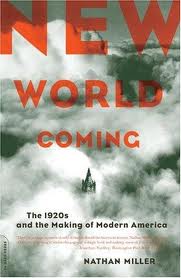
A review of Nathan Miller's New World Coming: The 1920s and the Making of Modern America (2003)
(Rating 5 of 5)
As I continue to march through the ages, I now come across Nathan Miller's guide to America in the 1920s. It was a decade that saw an incredible transformation of a nation and a people. This was the era where the motorized car did away with the horse and buggy forever. Sandwiched in between two world wars, the 1920s buzzed with excitement and wonder about the new age. This was the first decade that American women were able to vote in Federal elections. In this era, flight would start to become a more mainstream way of traveling and the skies of the major cities would see the rise of the new incredible feet of engineering: the Skyscraper. With the new popular HBO series Boardwalk Empire now heading into its second season, I would recommend this book as a great introductory guide. It presents a world where alcohol was illegal yet almost everyone was still drinking.
Leadership in the Twenties was lacking in comparison to the nation's first two decades in the twentieth century. The first fifth of the century the nation was led by the inspirational leadership of Theodore Roosevelt and Woodrow Wilson, and the president who was not as successful, William H. Taft—was a great man in his own right. The Twenties saw the leadership of the pathetic, to the boring, and ended with a disaster. Warren G. Harding started the decade off with his election which was the first time in American history in which women participated. It was unfortunate that such a sad president was the result of this historic occasion. Harding was not himself a bad man but he knew that he was not qualified for the job that the people had elected him to do.

(President Warren G. Harding, not that intelligent)
“'John, I can't make a damn thing out of this tax problem. I listen to one side and they seem to be right and then—God!--I talk to the other side and they seem just as right, and here I am where I started. I know somewhere there is a book that will give me the truth, but hell, I couldn't read the book. I know somewhere there is an economist who knows the truth, and I don't know where to find him, and haven't the sense to know and trust him when I find him. God, what a job!'” (p.88)

(President Calvin Coolidge, smarted than Harding but the personality of a rock)
Calvin Coolidge was smart but dull. He was known as the last nineteenth century president. It was under his leadership that the country went through great prosperity in the heart of the decade. Despite great economic success President Coolidge governed over a nation that had a growing cancer. This cancer, one of the nasty aspects of the 1920s, was raised to height of its power during the decade. The cancer was the hateful Ku Klux Klan. The Klan was more than just a terrorist organization. It was a hate group that extended its political power into the halls of Congress.
“Both Texas and Indiana were represented in the U.S. Senate by Klansmen, about seventy-five members of Congress owed their seats to the Klan, and the governors of Indiana, Georgia, Alabama, California, and Oregon had been elected with its support. In Oregon, where there were over 100,000 Klansmen in a population of 850,000, the Klan elected the mayor of Portland and would have succeeded in outlawing Catholic schools except for a ruling by the Supreme Court.” (p.145)
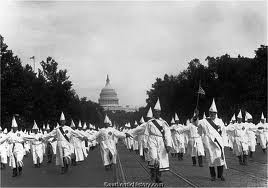
(Klan march on Washington)
Miller describes how the nation really changed in the Twenties was in the rise of the automobile. Although invented prior, the automobile really had its era begin in the Twenties. Miller compares the auto's impact to similar technological impacts such as television in the 1950s and the Internet in the 1990s. And the man who was at the front of the automobile's takeover of the American streets was Henry Ford with his Model T.

(Ford and the T)
“The Model T offered a combination of innovation and reliability, ruggedness and power never before seen in a reasonably priced automobile. Although derided as the Tin Lizzie, the car was built strong, yet light-weight chrome-vanadium steel, which Ford experts perfected after their chief picked up a sample from a wrecked French racer. Because of its lightness the car got twenty-five miles on a gallon of gasoline compared to the engine, which gave it a top speed of forty miles per hour, semiautomatic planetary transmission, and magneto, which supplied power for the spark and lights while doing with heavy storage batteries, were all new designs.” (p.180)
What Ford did was not only make great cars, but he made them affordable. Ford make them affordable by making them available. He made them available by creating the assembly line, in doing this he revolutionized the industry and made cars affordable to the common man and the common woman.
“'The man who places a part doesn't fasten it,' exulted Henry Ford. 'The man who puts in a bolt does not put on the nut; the man who puts on the nut does not tighten it.' He boasted that any job could now be learned in little time, with nearly half requiring only a single day. Labor costs were reduced because there was no need for skilled workers. Before the introduction of the assembly line, it took twelve hours to build a car; in 1914, the time dropped to ninety-three minutes.” (p.181-2)

(The Assembly Line)
The African-American community, oppressed with discrimination and segregation legally with terrorism and lynching illegally, found a method of resistance and cultural empowerment in the Harlem Renaissance. The center of African-American culture, Harlem, would be the intellectual breeding ground for the Civil Rights Movement that would, on the other side of the century, change the world.

(One of the great American poets, Langston Hughes)
“'On a bright December morning in 1921,' recalled poet Langston Hughes, 'I came up out of the subway at the 135th and Lenox into the beginnings of the Negro Renaissance.' While young white writers found their Mecca in Paris, Harlem was the center of the cultural and intellectual life of black America during the Twenties. If you were black and you wanted to write, you came to Harlem; if you were black and wanted to dance or sing, you came to Harlem; if you were black and you wanted to effect social change, you came to Harlem. Harlem was more than a geographic location—it was the soul and heart of African-American culture.” (p.220)
What most everyone remembers about the Twenties is the failed experiment of Prohibition. Not only did the government fail to stop people drinking, but by making drinking a crime they created a disrespect of the average person for law enforcement. It made heroes of bootleggers and other celebrity criminals. It helped create the rise of the mobster and the criminal rackets that would infiltrate local governments. Organized crime was already on the rise but the coming of Prohibition feed the beast and made it grow faster than it would have naturally.

(Al Capone, top mobster)
“Some of those involved showed a genius for business organization and made fortunes. Every major American city had its own underworld gang that peddled beer and booze and carved out territories for its distribution. Big Bill Dwyer was a longshoreman on the Brooklyn docks in 1920 and, three years later, was the largest importer of whiskey in the nation. Waxey Gordon—ne Irving Wexler—began his career as a pickpocket on the Lower East Side but, by the mid-1920s, owned a pair of skyscraper hotels, a brewery in New Jersey, and had an interest in a large distillery in upstate New York. Dutch Schultz controlled the beer business in upper Manhattan and the Bronx. In Detroit, the Purple Gang, a loose coalition of Jewish groups, liquidated the competition. In Boston, Charles Soloman assumed the role of boss; in Philadelphia, there was Max 'Boo Boo' Hoff; in Denver, Joseph Roma; in Cleveland, the Mayfield Road Mob. None had the power and influence of Chicago's Al Capone.” (p. 301)
Miller describes the rise of the modern celebrity obsessed culture that would get its first character with Charles Lindbergh. Lindbergh was made famous by the first solo flight across the Atlantic in which he made aviation history and became a national icon. The celebrity culture would also celebrate Babe Ruth the famous baseball slugger.

(Charles Lindbergh)

(Babe Ruth)
“Charles Lindbergh arrived on the scene as a culture of celebrity was taking root in America—a culture encouraged by the flashy new tabloid newspapers that were revolutionizing American journalism. Scandal, sex, and crime were the lifeblood of the tabloids—or half size—newspapers designed for subway straphangers. The New York Daily News was the first and most successful with a daily circulation of over a million copies. William Randolph Hearst's Daily Mirror and the Graphic—known as the Pornographic—imitated their rival with varying degrees of success. The taboos of genteel journalism had already been broken by the yellow journalism of Hearst and Joseph Pulitzer at the turn of the century, but the tabloids went even further with in presenting journalism as entertainment, gossip as news, the trivial and salacious as the drama of life—a trend that sent quality journalism into full retreat and has since taken over television.” (p. 329)
Second to Prohibition, the one thing most people remember about the 1920s is the way in which it ended. Black Thursday October 29, 1929 the day the stocks started to drop fast. What I found most interesting was the way Miller reminds his readers how the Great Depression came in waves. At first, on October 30, it did not seem so bad. But as the stocks continued to fall, banks began to close and firms followed which led to mass unemployment without any protection to the unemployed from the waves of the market. President Hoover had no idea how to act.
“Americans were puzzled—and then deeply angered—that a president who handed out relief to corporations could ignore the misery of people grubbing in garbage cans for food. No leader who permitted such a policy could maintain the confidence of his people. The Democrats won great gains in the 1930 off-year elections, including control of both houses of Congress. Hoover saw his name transformed into a symbol of derision: encampments of shacks erected by the homeless on the edges of the great cities were 'Hoovervilles,' broken-down automobiles pulled by mules were 'Hoover wagons,' and empty pockets turned inside out were 'Hoover flags.' He was the butt of a hundred bitter jokes. When he dedicated a monument and a twenty-one-gun salute boomed out, an old man was supposed to have said: 'By gum, twenty-one chances and they missed him.'” (p.380)

(President Herbert Hoover)
Miller does a great job at bringing the 1920s and the America of that era to his readers. My only one complaint was like like the Restless Decade there are no visuals (photos, political cartoons, or election maps). Nevertheless this is a great book that I would recommend to anyone with an interest in this time period or just likes the show Boardwalk Empire.
{Video from the hit HBO series Boardwalk Empire}