Jeremy A. Perron's silly attempt to organize his thoughts on all the history books he has read. This is being done for reasons only he can really understand.
A review
of Hampton Sides’ Ghost Soldiers: The Epic Account of World War II’s
Greatest Rescue Mission (2001)
(Rating 4 of 5)
Ghost Soldiers is duel story of soldiers who were captured in the
Philippines, made prisoners of the Japanese for years—many forced to undergo
the Bataan Death March—, and the team of soldiers that rescued them.It is a story of human suffering, war,
inhumane cruelty, and heroism.
Sides
tells a great tale and writes incredible book.Nevertheless the book is a difficult read, and despite being only three
hundred pages, it took me almost a month to get through it.The reason it is difficult is not due to a
complicated structure of the book, quite the contrary, Sides has a beautiful
smooth flowing narrative.The actual
reason is the horrendous war crimes depicted in this book by the Japanese
against the American POWs and the Filipino civilians is difficult to stomach. I
often found myself having to put the book down in anger.
I don’t want to make it appear that
the Japanese are inherently evil and the Americans and Filipinos are saints. The fact is every culture has bad parts in its
history and this book does make an effort draw attention to some Japanese
officers who were opposed to what was going on.
If
Hollywood is looking for fresh movie ideas it should turn here.It is like Schindler's List with a
military rescue mission.I would
encourage anyone to read it.
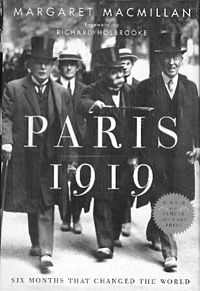
A review of Margaret Macmillan’s Pairs 1919: Six Months
That Changed the World (2001)
(Rating 4 of 5)
Margaret Macmillan gives an incredible account of one half
of am important year.That year, 1919, was both a
historical and horrible year at the same time.For centuries the foreign policy of nations had been in the Metternichian school of
realism based on the ‘balance of power’ and the winner taking the spoils.1919, however began with the birth of new
kind of foreign policy: idealism.Wilson
and his fourteen points were to rewrite the rules of old and bring forth a more
just foreign policy.No longer were
international conflicts about the strong prevailing over the weak in the
anarchy of nations, the old ways were to be replaced with sensible law and
order with justice as the prevailing principle.These efforts ended in failure.
In some
ways it was not Wilson’s fault.Political realism is called that for a reason.Europe had a long history, far longer than
his United States.The Ottoman Empire
first rose to power after finishing off the Byzantine-Romans in 1453, almost
forty years before Christopher Columbus went on his first voyage. Now that
Empire was going to die after centuries of decline. Arguing over who deserved
to own what after centuries of war, conquest, and re-conquest, was not going to
be an easy task for anyone involved.
The Big four Vittorio Orlando, David Lloyd George, George Clemenceau, and Woodrow Wilson
Macmillan
takes her reader on a guided tour through this year exploring the war torn parts
of the globe area by area.She explains
to the reader the basic needs of each interest in the conflict.Many liked Wilson’s ideas, even if they had a
hard time understanding them.
“Of all the ideas Wilson brought to
Europe, this concept of self-determination was, and has remained, one of the
most controversial and opaque.During the
Peace Conference, the head of the American mission in Vienna sent repeated
requests to Paris and Washington for an explanation of the term.No answer ever came.It has never been easy to determine what
Wilson meant.” (p.11)
Many who
argued ‘self-determination’ in Eastern Europe had a hard time understanding
their ‘natural country’ may not be as big as their history told them it should
be.
The German
Empire had gone to war against the Allies.Upon Germany’s defeat the Kaiser was overthrown and a Republic
established.It would have been in
everyone’s best interest if the new Republic were welcomed with open arms by
victorious nations.History took a different turn. France was angry
wanted revenge, not just its lost provinces restored—that was going to
happen—but France wanted to see Germany humiliated.France wanted Germany to have to pay
reparations and accept sole responsibility for the cause of the war.
Clearly one of the dumbest men ever to rule a nation, Kaiser Wilhelm II
It was absurd to suggest that
Germany was the sole power responsible; it wasn’t even the first to declare
war.However, France had to pay
reparations when Prussia humiliated her in 1870.That was when the German Empire was
established with Wilhelm I as Kaiser.France could not take the defeat and deposition of Kaiser Wilhelm II,
grandson of the Wilhelm I, as revenge enough.They had to have revenge on the German people is well.The Third French Republic and its allies set the
German Republic up to fail.
“In the dark days of 1917, when the
French armies had been shattered on the Western Front and there was and there
was talk of collapse at home, Clemenceau the Father of Victory, as the French
called him, finally came into his own.As prime minister, he held France together to final victory.When the Germans made their last great push
toward Paris in the spring of 1918, Clemenceau made it clear that there would
be no surrender.If the Germans took the
city, he intended to stay until the last moment and then escape by plane.”
(p.31)
I have only one complaint about the
book.Capitalization.I am sorry but it should be British Empire,
Roman Empire, Ottoman Empire, etc.Not
British empire, Roman empire, and Ottoman empire.I know it is a style now but it is one that I
think needs to go away.
Aside from the grammatical style, this is a great
book.It takes you from the rooms of
Woodrow Wilson, David Lloyd George[1],
and George Clemenceau, to the frontiers of China and everything in between.Chapter 1 of the modern world begins
here.Macmillan correctly points out
that World War II was not because of the Treaty of Versailles but the history
that happened in-between, nevertheless Europe did not receive a good start in
1919.
[1] Even
though the author is Lloyd George’s great-granddaughter she has an easy time
portraying him as another famous commoner said, ‘warts and all.’
A review of Thomas J. Knock’s To
End All Wars: Woodrow Wilson and the Quest for a New World Order (1992)
(Rating 4 of 5)
Thomas
Knock’s book To End All Wars is a study of President Wilson’s foreign
policy.There is a bit of a
mini-biography in the beginning the traces President Wilson’s intellectual
development and rise to the presidency.Everything else focuses on the President’s work abroad. In his first term
the book's focus is on United States’ relationship with other nations in the
Americas.The Knock's focus on second term
is partly on World War I but more so the battle to create the League of
Nations.
One of the ironies the Knock points
out is: with all the major foreign policy issues that would arise with
President Wilson’s time in office, the 1912 election had almost nothing to do
with foreign policy.Knock however is
quick to defend Wilson’s own remark about how it would be ironic if foreign policy were
to cover his Administration.Knock
argues that Wilson’s comment was based on the content of the election campaign
not on his personal study of the issues.
“The election of 1912, like almost
all the others of the preceding century, did not hinge on foreign policy.
President Taft now and then reflected upon his futile exertions for reciprocal
trade with Canada and arbitration treaties with the European powers. Debs
viewed foreign policy as irrelevant to working-class interests, just as he had
done during the debate over imperialism in 1900. The Progressive platform
advocated free passage through the Panama Canal for American coastwise shippers
and recommended the construction of two battleships per year, while the
Democratic platform called for independence for the Philippines. But none
of the candidates said much about even these rather innocuous issues.” (pg. 19)
Wilson
was an idealist but Wilson was not alone in his idealism.There were many people and movements on both
sides of the political spectrum who wanted to change from the theories that used
balance of power and national interest in guiding foreign policy, and to
replace it with a new internationalism that would embrace the rule of law over
nations.
“Jane
Addams played a key a pivotal in this wing of the internationalist movement;
indeed, she personified its purposes and values perhaps better than anyone
else. Dismayed by the failure of the established peace societies to show
any muscle, Addams, with the help of Paul Kellogg and Lillian Wald, organized the
Woman’s Peace party in January 1915. The Woman’s Peace party
distinguished itself as the first organization of its kind--unlike the Carnegie
Endowment for International Peace or the World Peace Foundation--to engage in
direct political action (and on a variety of fronts) in order to achieve its
goals.” (pg.50-1)
There
is very little in this book about World War I as a conflict.It discusses how Wilson had America enter as
an associate belligerent power rather than an ally.Wilson was disgusted with the allies and
their plans to divide up the spoils after the war.Wilson wished for a new way of doing things and the actions of the allies, to him, represented what was wrong with the world.
“In
addition to arbitration, Wilson concentrated on disarmament. Sounding
much like a card-carrying member of the American Union Against Militarism, he
posed to alternatives to his audiences--disarmament through the League or the
eventuality of a national security state. Should it stand apart, he
argued, the United States would have to be ‘physically ready for whatever
comes.’” (p.261)
Wilson’s view of what America might become has become reality.I am not sure his ideas for change were a realistic alternative.The League was not worth much and even the
U.N. that replaced it has some terrible flaws.It is ironic that the ship Wilson used to go France in was the called
the George Washington.I can
think of no president whose views on foreign policy were closer to the exact
opposite of Wilson than Washington.I am
not talking about entangled alliances either.Washington was a realist who felt that nations would only go along with whatever
aligned with their interests.Wilson
talked of ‘equity of nations’.Why would
a great power like Great Britain want to be on an equal footing with Luxemburg?Wilson’s goals were admirable and maybe one
day be attainable, but his methods were questionable at best.
Morris’ earlier book The Rise of Theodore
Roosevelt that focused on the mere forty-two years Roosevelt went from
birth to being the President of the United States, the fastest rise on
record.The election of 1900 was
supposed to silence the rebellious Governor of New York by making him the Vice
President.However when an assassin’s
bullet mortally wounded President McKinley fate put Roosevelt in a great
position to act. This book covers the accomplishments and failures of an administration.
The first
thing of significance that Roosevelt decided to do was infuriate the entire
solid south over their favorite issue: Black people.Booker T. Washington was the least offensive
African-American that white southerners could ask for.Popular in the African-American community in
his own time, Washington has since fallen out of favor after the ‘black power’
movement in the 60s and 70s.Washington’s philosophy was focused on practical things now, political rights
later.Roosevelt, on race, was enlightened
for his time, although not quite with ours.He tended to agree with society’s view on race (that White people were
the best), but Morris points out that Roosevelt viewed was different in that he
thought White supremacy would be temporary.He thought races could become better as time went on and ‘catch up’, and
that each individual should be judged on his or her own merits.And Roosevelt thought absolutely nothing
about inviting the accomplished Washington to the White House for dinner, but
the South had other ideas.
“The storm squalled louder when
reporters discovered that Roosevelt had entertained blacks before, in the
gubernatorial mansion at Albany and at Sagamore Hill.Hate mail and death threats swamped the White
House and the Tuskegee Institute.In
Richmond, Virginia, a transparency of the President’s face was hissed off the
Bijou screen.In Charleston, South
Carolina, Senator Benjamin R. Tillman endorsed remedial genocide: ‘The action
of President Roosevelt in entertaining that nigger will necessitate our killing
of a thousand niggers in the South before they will learn their place again.’”
(p.55)
One has to
wonder how Senator Tillman would react after the 2008 election.
Booker T. Washington and Theodore Roosevelt
After
infuriating the South the new President decided to take on the seemingly
all-powerful trusts.When Northern
Securities Co. threatened to take over all the railroads in the United States,
it was President Roosevelt who stood up and stopped it.Morgan was shocked because no President of
the United States had ever stood up to him before.
“Whatever qualms the President may
have had in granting an interview, he had little difficulty handling
Morgan.Or at least Roosevelt chose not
to remember any, when recounting the conversation afterward.Morgan had seemed less furious than
puzzled.Why had the Administration not
asked him to correct irregularities in the new trust’s charter?
Roosevelt: That is just we did not want to do.
Morgan: If we had done anything wrong, send your man to my
man and they can fix it up.
Roosevelt: That can’t be done.
Knox: We don’t want to fix it up, we want to stop it.
Morgan: Are you going to attack my other interests, the
Steel Trust and others?
Roosevelt: Certainly not—unless we find out that in any case
they have done something we regard as wrong.
Alone with Knox later, Roosevelt
mused, ‘That is a most illuminating illustration of the Wall Street point of
view.’Morgan could think of the
President of the United States only as ‘a big rival operator’ with whom he
could cut a deal.” (p.91-2)
Roosevelt vs. the Trusts
Roosevelt
would gain a reputation for being pro-labor, but he was not pro-labor so much
as he was pro-fairness, and for the last few decades management did not need to
negotiate as the government was always there to back them up.Roosevelt moved the government into a more
neutral corner, and allowed for labor to deal in a fairer environment.
“Some weeks after the Coal Strike
Commission had begun its work, and anthracite fires were glowing in forty
million grates, George Baer encountered Owen Wister and roared at him, ‘Does
your friend ever think?’The railroad
executive was still furious over Roosevelt’s ‘imperious’ intervention between
free-market forces.Even the most
conservative economic experts were predicting that United Mine Workers would
win at least 10 percent wage increase, plus fairer and safer working conditions
and the right to arbitrate all disputes.” (p.169)
Roosevelt
shared the international stage with a host of other characters.King Edward VII of England was one who
Roosevelt rather liked.One who
Roosevelt despised was King Edward’s psychotic nephew, Kaiser Wilhelm II of
Germany.
“What made Roosevelt wary was
Wilhelm’s inclination toward bejeweled fantasy.‘He writes to me pretending that he is a descendent of Frederick the
Great!I know better and feel inclined
to tell him so.’The Kaiser liked to
dress up like Frederick; when he posed for photographs in his hero’s
thigh-boots he revealed rather wide hips.Roosevelt, alive to any hint of effeminacy, understood that in
negotiating with Wilhelm he must at all times remember the importance of
show.It would be foolhardy to humiliate
him in the Caribbean.The Kaiser was
enough of a man to stand tough, confidential message—and enough of a woman,
presumably, to retreat if it could be made to look glamorous.” (p.186)
Roosevelt’s
most famous and long-lasting accomplishment was the Panama Canal.When Columbia decided to back out of its deal
with the United States Roosevelt turned his eye to a little revolution that was
going in the province of Panama.If
Columbia did not want to deal than perhaps the revolutionaries would.
“There was no doubt now that the
province would soon—must—secede from the Colombian federation.Bogota’s rejection of the canal treaty, and
Washington’s apparent acceptance of that rejection, amounted to dual deathblows
to the Istmusenos.Not only had
they lost their long-dreamed waterway, spilling wealth on both sides forever,
but their railroad, too, would become redundant, once the Nicaragua Canal
opened for business.With no paved
highways, no bridges, little industry, and less commerce, they might just as
well revert to jungle living.
The President could not help
feeling sympathetic.Here was a little
ridge of country, about as wide as southern Vermont, a half-drowned hogback of
mostly impenetrable rain forest, walled off from the rest of Colombia by
mountains.Geographically, it belonged
to Central America.Its only surface
communications with the southern continent were by sea or mule train.Letters took fifteen days to get to Bogota,
if they got there at all; about the only reliable deliveries were those
carrying tax money out of the Isthmus.
Panama’s political status as a provincia
of Colombia was equally tenuous.It had
spontaneously joined the New Granadian Federation in 1821, and seceded with its
disintegration in 1830.Bogota had
reasserted control twelve years later, and from then on Panama had alternated
stormily between semi-autonomy and subjugation.Roosevelt counted no fewer than fifty-three isthmian insurrections,
riots, civil disturbances, and revolts since 1846.None had been perpetrated with any American
help.On at least ten occasions (six
times at Bogota’s request, twice during his own presidency), Washington had
blocked rebel movements and shipments along the Panama Railroad.” (p. 273)
It is easy to see how useful the Panama Canal was
No
President who entered the office by means of succession was ever elected—much
less nominated—to a term of their own.Roosevelt would achieve both at the expense of the party elders and
conservatives.Roosevelt would redefine
how a President campaigned to retain his office.After President Jackson, only three incumbent
presidents retained their office after a presidential election. (Lincoln,
Grant, and McKinley)In over a hundred
years since Roosevelt left office only five have failed to retain it. (Taft,Hoover,
Ford, Carter, and Bush I)
“In the meantime, the President
felt free to set his own Republican agenda, in a series of indiscretions
calculated to heave fresh sod on Hanna’s grave.He preached conservation to the National Wholesale Lumber Dealers’
Association, and political morality to Republican professionals.He meddled in the gubernatorial politics of
New York and Missouri, ordered a draft platform for the convention, considered
and approved a mysterious proposal to translate American campaign literature
into Bohemian, and grossly flattered the first national assembly of American
periodical publishers: ‘It is always a pleasure for a man in public life to
meet the real governing classes.’
Old Guard Republicans worried about
the undignified spectacle of a President campaigning for his own office.He was supposed to put himself in the hands
of party professionals.McKinley had
successfully sat out two campaigns at home in Canton, Ohio; here was ‘Teddy’
virtually setting up pre-convention headquarters in the White House.” (p.319)
Roosevelt
loved being a member in the party of Lincoln; it was Roosevelt who put Lincoln
on the penny.John Hay, Lincoln’s
personal secretary, who was U.S. Secretary of State when Roosevelt took office,
gave him a special ring to where at his inauguration in 1905.
“Close observers noticed a strange,
heavy gold ring on his third finer.It
contained a strand of Abraham Lincoln’s hair.John Hay had given it to him with a request that he wear it when he was
sworn in: ‘You are one of the men who most thoroughly understand and appreciate
Lincoln.’” (p.376)
Another
great Roosevelt achievement that occurred in Kittery, Me, despite the claim
that it took place in Portsmouth NH. In Kittery, Roosevelt mediated the settlement of the result of the war between Russia and Japan.Roosevelt had a great respect for Japan and could not stand the Tsar or
his government.The great challenge for
Roosevelt was having to deal with a Tsar that did not want to deal with
reality.
“Roosevelt detected a resurgence of
the Russian lack of logic that had so infuriated him with Count Casini.His Majesty would not give up Sakhalin, yet
Sakhalin, was already occupied by the Japanese.Russia was not conquered—she had merely been beaten in every land battle
of the war, and lost almost all of her navy.He soil was undefiled, but if she did not soon treat with Japan, she
could say good-bye to eastern Siberia.” (p.410)
Treaty of Portsmouth
The one
sour spot on Roosevelt’s record was his action during the Brownsville
Affair.Some African-American
infantrymen were accused of murdering a bartender and injuring a cop.When none came forward Roosevelt discharged
the entire black regiment for engagement in a ‘conspiracy of silence’.These orders would not be reversed until the
Nixon administration.
“Roosevelt remained silent.He closeted himself with the original
Brownsville report of Major Blocksom, rereading it carefully.Its findings did not alter his conviction as
to the guilty of the men.But after
studying another view of the case, by a retired Union Army general, he betrayed
the first trace of regret over the hastiness of his action.He wrote Taft a confidential note, saying he
was now ‘uncertain whether or not the officers of the three colored companies…
are or are not blamable,’ and asking for ‘a thoro investigation’ to clarify his
thinking.”(472-3)
Roosevelt’s
crowning achievement on his presidency was the ‘Great White Fleet’.Ever since he was a boy he loved his
country's Navy.He wrote the Naval
War of 1812 and served as Assistant Secretary of the Navy as an adult.After Roosevelt was done the U.S. Navy had
become the third best in the world ranking only under Great Britain and
Germany.The tour of the Great White
Fleet confirmed it.
“Roosevelt considered the options,
and his own as President and Commander-in-Chief.He had just seventeen months left in office,
and wanted to make a grand gesture of will, something that would loom as large
historically in his second term as the Panama Canal coup had in his first.What could be grander, more inspirational to
the Navy, and to all Americans, than sending sixteen great white ships halfway
around the world—maybe even farther?” (p.494)
Great White Fleet
Morris’ book is very well done.It has a great following narrative and would
be enjoyable to someone who knows a lot about history or a causal reader.In terms of style I really like that he
includes his pictures within the text not in a separate section like many other books
do.I really like the
capitalization.Morris is thorough back
who capitalizes titles, as I believe we should.I would recommend this book to anyone.